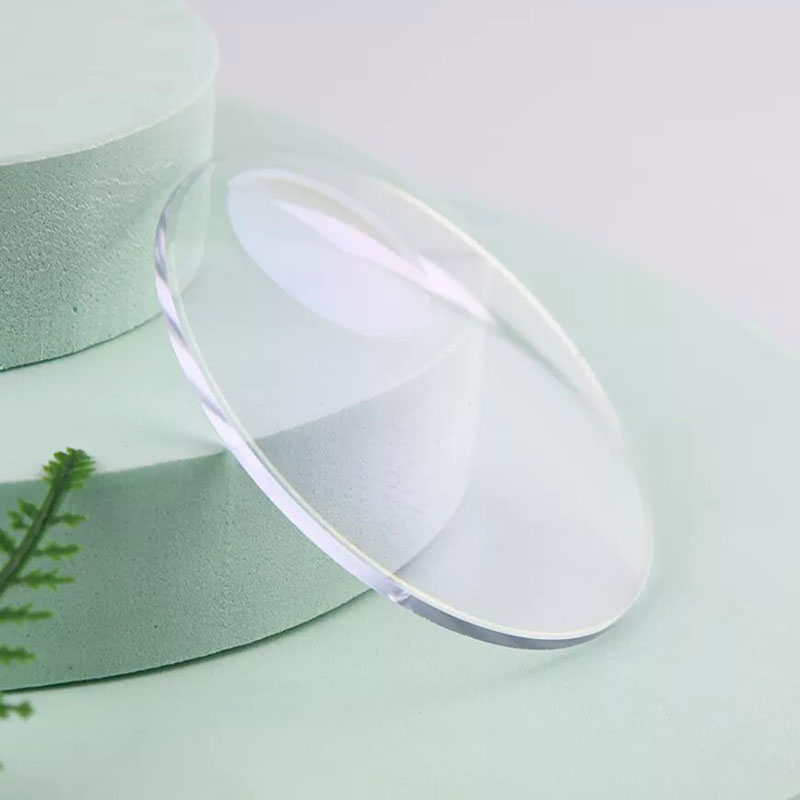



Design Principles and Visual Distribution of Progressive Multifocal Lenses
The core of Progressive Multifocal Lenses (Progressive Lenses) lies in their aspheric geometric design . Unlike standard single-vision lenses with a constant curvature, the surface curvature of a progressive lens changes continuously from top to bottom. This design mimics the natural accommodation process of the human eye, allowing the wearer to obtain clear vision at far, intermediate, and near distances through a single lens.
Division of Core Visual Zones
Progressive lenses are functionally divided into four key areas:
Distance Zone: Located at the upper portion of the lens, used for viewing objects beyond 5 meters. The power corresponds to the user’s distance prescription.
Near Zone: Located at the bottom of the lens, providing power compensation (ADD) for reading distances of 33-40 cm, optimized for reading, writing, or using a smartphone.
Intermediate Zone: A narrow transition corridor connecting the distance and near zones, where the power increases smoothly from top to bottom. This area is suitable for viewing computer screens, dashboards, or items on a counter.
Distortion Areas (Peripheral Astigmatism): Located at the lateral edges of the lens. Due to the physical limitations of continuous curvature change, light cannot be precisely focused in these peripheral areas, resulting in blur or a sense of swaying.
Parameter Comparison: Impact of Design Types
Based on the distribution of peripheral astigmatism, progressive lenses are mainly classified into Hard Design and Soft Design , each focusing on different visual ranges and comfort levels:
| Performance Metric | Hard Design | Soft Design |
|---|---|---|
| Distance Field of View | Wider, high peripheral clarity | Narrower, slight peripheral astigmatism |
| Near Field of View | Broad, ideal for long reading sessions | Moderate, blurred visual boundaries |
| Transition Corridor | Shorter, rapid power change | Longer, gradual power change |
| Peripheral Astigmatism | Dense astigmatism, noticeable distortion | Dispersed astigmatism, softer vision |
| Adaptation Difficulty | Higher, prone to dizziness for beginners | Lower, easier to adapt to motion vision |
| Target Audience | Experienced users or high near-vision users | First-time wearers or active/driving users |
Parameter Considerations for Corridor Length
Corridor length is the vertical distance from the center of the distance zone to the point where the maximum near power is reached. This is a critical physical parameter when choosing frames:
Long Corridor (14mm - 17mm): Provides the smoothest visual transition and comfortable intermediate vision for computers. Requires larger frame height (typically B-size > 30mm).
Short Corridor (11mm - 13mm): Fits smaller, more fashionable narrow frames. However, it features a stronger visual jump effect and an extremely narrow intermediate zone.
Scientific Laws of Distortion Areas
According to Minkwitz's Theorem in optics, the rate of lateral astigmatism change in a progressive lens is directly proportional to the Addition (ADD) power and inversely proportional to the corridor length. Modern Free-form technology effectively reduces this physical distortion by distributing the progressive design on the back surface or both sides of the lens, expanding the field of view by approximately 20% - 30% .
Core Advantages of Progressive Multifocal Lenses
Progressive lenses are considered all-around optical products due to their dual advantages in physiological visual simulation and social aesthetics. Compared to traditional lenses, they excel in multi-tasking and visual appearance.
Continuous and Natural Visual Perception
The greatest physical advantage of progressive lenses is the stepless transition of power.
Elimination of Image Jump: Traditional bifocals have a distinct physical line. When the line of sight crosses this boundary, the object appears to jump. Progressive lenses ensure a stable and continuous image as the gaze shifts.
Simulating Natural Eye Accommodation: They most closely resemble the natural zooming state of the human eye during youth, allowing wearers to find the clearest focus through subtle adjustments of head posture.
Balance Between Visual Function and Social Aesthetics
Multi-scenario Applicability: These lenses integrate all visual distances into one. Wearers do not need to frequently switch glasses between driving, office work, and reading.
Age Privacy Protection: The lens surface is smooth without the visible segments or lines found in bifocals. Externally, they look identical to regular single-vision lenses.
Parameter Comparison of Different Lens Solutions
| Performance Dimension | Single Vision | Bifocals | Progressive Lenses |
|---|---|---|---|
| Correction Range | Single distance only | Far Near only | All distances (Far, Mid, Near) |
| Intermediate Vision | Missing (Computer is blurry) | Missing (Visual gap exists) | Clear (Dedicated corridor) |
| Aesthetic Appearance | Excellent (Transparent) | Poor (Visible line/segment) | Excellent (Seamless design) |
| Image Jump | None | Severe (At the line) | None (Smooth transition) |
| Postural Naturalness | Requires frequent switching | Relatively restricted | Most natural (Micro-adjustments) |
Key Technical Indicators and Lens Classification
The technical evolution of Progressive Lenses has moved from standardized molds to highly digitized customization.
Classification by Surface Design
Performance depends heavily on how the progressive surface is processed:
Front-Surface Progressive: The progressive curvature is on the front. This traditional design limits the field of view because the progressive layer is further from the eye.
Back-Surface (Internal) Progressive: The progressive curvature is on the back (closer to the eye). This shortens the vertex distance, expanding the field of view by 20%-30% .
Dual-Surface Progressive: Distributes vertical power change and horizontal astigmatism control across both surfaces, providing the widest possible visual corridor.
Processing Precision: Traditional vs. Free-form
| Parameter | Traditional Processing | Free-form Technology |
|---|---|---|
| Processing Precision | Approx. 0.12D - 0.25D | 0.01D |
| Customization | Standardized molds | Highly customized (Prescription, frame, face shape) |
| Astigmatism Control | Poor, noticeable peripheral blur | Excellent , effectively shrinks distortion |
| Field of View | Narrower | Significantly expanded |
| Adaptation Period | Longer (1-2 weeks) | Extremely fast (Often immediate) |
Functional Classifications
Everyday/Standard: Balanced fields for far, middle, and near. Suitable for all-day wear, including driving and walking.
Office/Occupational: Prioritizes intermediate and near vision . Ideal for long hours at a computer but not suitable for driving.
Short Corridor: Specifically for narrow frames, with rapid power changes to ensure near vision is accessible in small lens heights.
Fitting Process and Key Factors for Success
Fitting Progressive Lenses is a highly precise process. A deviation of just 1mm can cause blur or dizziness.
Pre-fitting Adjustment: Position of Wear (POW)
Before measuring parameters, the frame must be adjusted to the wearer's most natural state. This includes ensuring Frame Stability , checking the Frame Wrap (horizontal curvature), and the Pantoscopic Tilt (forward tilt toward the cheeks).
Core Measurement Parameter Comparison
| Parameter | Definition | Standard Value | Consequence of Error |
|---|---|---|---|
| Monocular PD | Pupil to nose bridge distance | Individual | Corridor misalignment |
| Fitting Height | Pupil center to frame bottom | Usually > 18mm | Blurry distance or near vision |
| Panto Tilt | Angle of lens to vertical | 8 - 12 degrees | Reduced near field clarity |
| Vertex Distance | Lens to cornea distance | 12mm - 14mm | Changes effective power |
Behavioral Guidance for Adaptation
Move Your Head, Not Just Eyes: When looking sideways, turn your head slightly to align the pupil with the clear central corridor.
Finding the Focus: For reading, keep your head still and lower your eyes. Adjust chin height slightly if the text is not clear.
Stair Safety: Tuck your chin in when going downstairs to look through the distance zone at the top of the lens, avoiding the floating ground effect.
Progressive Lens FAQ
Adaptation and Comfort
Q: Why do I feel dizzy or see the ground swaying?
A: This is the Swim Effect . The brain needs a neural adaptation period of 3-14 days to filter out the peripheral distortion signals.
Q: How do I know if it is an adaptation issue or a wrong prescription?
A: If dizziness persists after a week, or you must tilt your head excessively to see, it is likely a Fitting Height or prescription error.
Impact of Parameter Fluctuations
| Symptom | Possible Parameter Issue | Suggested Adjustment |
|---|---|---|
| Blurry distance, clear when bowing head | Fitting Height is too high | Lower the frame or redo lenses |
| Reading zone is too narrow | PD is inaccurate or ADD is too high | Verify PD, check astigmatism width |
| Ground looks slanted/domed | Poor astigmatism control or tilt | Reduce tilt or switch to soft design |
Common Usage Myths
Q: Can I wear Progressive Lenses for driving?
A: Yes. The upper zone is for distance. When checking mirrors, turn your head slightly rather than just moving your eyes.
Q: Why is my field of view narrow on the computer?
A: Standard progressive corridors are narrow. For 6 hours of computer work, an Office Lens is recommended to expand the intermediate field.
Maintenance and Identification
Q: What are the faint engravings on the lens?
A: These are laser markings including ADD power and alignment points, used by opticians to verify the fitting accuracy.
Q: Why are my lenses thicker than others?
A: Higher ADD power increases lens thickness. Users with high ADD should choose high-index materials such as 1.67 or 1.74 .